It is recommended to plant garlic 2-3 weeks before the ground freezes. So today I am planting the rest of our local garlic that I had saved for seed cloves. November 15, 2015.
Fall planted garlic sometimes shows green shoots before winter. It is not uncommon for garlic to sprout prematurely a little before winter. The tops will die back off with the winter and grow again in the spring. Garlic is extremely hardy in our climate on Gabriola and can handle this cycle.
To help protect the young sprouts I have decided to cover them with 5-6" of composted organic matter. A combination of leaves, straw and grass clippings works good for this. In the spring the shoots will continue to grow right up through this blanket of organic material.
November 20, 2015 I have added a layer of rug underlay over my raised garlic bed as we have been have so much rain and colder weather. The garlic had started to sprout but I was afraid it would drown and rot in all the moisture.
Garlic is suppose to "easily withstand the winter temperatures in BC Coastal areas". You supposedly don't need to worry about frost as garlic tolerates the cold.
In the early spring spray the garlic foliage with diluted liquid fish emulsion.
Garlic does not like lots of water. Mulching is a way of maintaining moisture. Not enough moisture and the garlic will not develop a full size bulb. Over-watering results in burst skins, mold, and poor keeping qualities. Stop watering a few weeks prior to harvesting.
Hard-neck garlic produces a central stalk that goes straight up and then usually makes one or two loops. If you want the plants energy to go into producing a large bulb, cut the scape off after it has made 2 loops.
Life on Gabriola Island. Hope you'll enjoy the journey along with me as I paint, travel and enjoy life. Welcome to my world.
Tuesday, January 5, 2016
Wednesday, December 23, 2015
Winter Plants on Gabriola Island 2015
Clothed in a multitude of layers, including underwear, I am off to do a tour of our garden to see how the plants have survived the heavy rains we have been having. It is 3* C today with high humidity and it is chilly out. It is a day when it isn't pouring down rain. There aren't many other gardeners on this island who are going out to check to see how their plants are doing. Most are content to stay indoors by the woodstove until things warm up a bit more out there.
Our plants haven't liked all the rain and the cold snap and they stand forlornly waiting for it to pass. It seems like the rhodos have pulled their leaves in towards their bodies as if they are cold. I have been assured it is the plant's way of taking it's external energy from it's leaves back into it's core until the temperature warms again. It is hibernating. As the temperature warms, the leaves will open again and reach up to the sun.
Then I notice that the rhodos that have pulled their leaves in close also have new flower buds growing. At the same time do they think spring is near?
Our camellia tree has started to form some nice flower buds on it, too. This tree had a lot of seed pods on it this fall. Most of the seeds have dropped off but some have burst open and remain on the tree.
Snowdrops are magically peaking through the composting dead leaves which cover the ground. This is astounding as it is only December.
I lift the leaves on the helleborous "niger", commonly known as the Christmas Rose to find new flower buds just pushing up out of the ground.
Our plants haven't liked all the rain and the cold snap and they stand forlornly waiting for it to pass. It seems like the rhodos have pulled their leaves in towards their bodies as if they are cold. I have been assured it is the plant's way of taking it's external energy from it's leaves back into it's core until the temperature warms again. It is hibernating. As the temperature warms, the leaves will open again and reach up to the sun.
Then I notice that the rhodos that have pulled their leaves in close also have new flower buds growing. At the same time do they think spring is near?
Our camellia tree has started to form some nice flower buds on it, too. This tree had a lot of seed pods on it this fall. Most of the seeds have dropped off but some have burst open and remain on the tree.
Snowdrops are magically peaking through the composting dead leaves which cover the ground. This is astounding as it is only December.
I lift the leaves on the helleborous "niger", commonly known as the Christmas Rose to find new flower buds just pushing up out of the ground.
Tuesday, December 22, 2015
Quiet Winter on the Island
It is the start of winter here. The ground is cold but not frozen. The trees have lost their leaves. I feel the retraction of the sun and the shift to cloudier days and longer nights. On this island, winter brings with it a dragging grayness in the sky. I will admit I do struggle through the winter. I miss the blue sky and sunlight. At home I seek out warmth, a wood fire, a cup of hot tea, a cozy blanket, extra socks and a good book. I read, I write, I paint and I cook.
It is quiet on the island, the tourists and summer companies have all gone home. Although I love the peace and quiet I find that I must discipline myself to get out of the house as I could turn into a hermit. I use photography as a means to record things that appeal to me. Color, shape, line, texture and mood can be caught in a photo. I find it interesting to take photos of the winter fog.
...and the fog rolls in again ... a white darkness...
It is quiet on the island, the tourists and summer companies have all gone home. Although I love the peace and quiet I find that I must discipline myself to get out of the house as I could turn into a hermit. I use photography as a means to record things that appeal to me. Color, shape, line, texture and mood can be caught in a photo. I find it interesting to take photos of the winter fog.
...and the fog rolls in again ... a white darkness...
Thursday, September 24, 2015
Wild Turkeys
It seems like the population of wild turkeys is flourishing and increasing on Gabriola Island. At night the wild turkeys roost up on the power lines and in trees as they can fly short distances.
Tom turkeys show courting behaviors much like the peacock with displays of their tail feathers. The male turkeys have a red wattle (piece of skin that hangs down under their chin) and a knob on their foreheads.
Male wild turkeys are called gobblers. One male mates with many females. We have seen the males strutting down the road with their tails fanned out while trying to attract the females. Females are called hens.
A group of turkeys may be called a crop, or posse or a gang. Here is the new crop of wild turkeys on Gabriola.
Here is Geo and is posse of wild turkeys going for their walk.
...and for Thanksgiving I wonder how many will be eating wild turkey for supper on Gabriola Island.
Tom turkeys show courting behaviors much like the peacock with displays of their tail feathers. The male turkeys have a red wattle (piece of skin that hangs down under their chin) and a knob on their foreheads.
Male wild turkeys are called gobblers. One male mates with many females. We have seen the males strutting down the road with their tails fanned out while trying to attract the females. Females are called hens.
A group of turkeys may be called a crop, or posse or a gang. Here is the new crop of wild turkeys on Gabriola.
Here is Geo and is posse of wild turkeys going for their walk.
...and for Thanksgiving I wonder how many will be eating wild turkey for supper on Gabriola Island.
Swiss Chard - 2015
Swiss chard is easy to grow and is very nutritious. Last year I planted 4 non bolting Swiss chard plants and barely watered them as we were gone most of the summer. I read somewhere that you could just trim this type of chard down and it would grow back. Indeed it does and we had Swiss chard growing from the same roots all this summer. Nice! The plants are very hardy and the chard is delicious. Pinch off the tops of the plants to encourage new growth.
Just pick it, wash it, chop it and put it in a pan with a drop of olive oil and just a drop of water. Cook till tender. Do not boil it the old fashion way and loose all the nutrients.
Tomatoes- 2015
I decided to plant my tomato plants in big pots this year. This way I could try a different part of our yard without building raised beds so that I could see if there would be enough sunlight for them.
Last year the back yard was shaded most of the afternoon and did not seem to get enough light.
Planting the young plants in pots also got rid of the problem of slugs eating them. The problem that did show up in one plant was blossom end rot which was fixed with the quick addition of lime for the calcium deficiency.
Considering that we were away in May and I did not get them planted until the beginning of June they have done not to bad. I planted four different varieties in pots.
Last year the back yard was shaded most of the afternoon and did not seem to get enough light.
Planting the young plants in pots also got rid of the problem of slugs eating them. The problem that did show up in one plant was blossom end rot which was fixed with the quick addition of lime for the calcium deficiency.
Considering that we were away in May and I did not get them planted until the beginning of June they have done not to bad. I planted four different varieties in pots.
Dahlias
My dahlia plants have struggled all summer. First it was slugs eating the new shoots and then the hot dry weather came. Now that it is nearing the end of September they have started to perk up with the recent rains that we have been having.
Entrance Island
It doesn't matter what time of the year it is, or the time of the day. Olebar Point is a good place to go for a walk and to take pictures of Entrance Island. There is always a beautiful view from here.
Saturday, September 19, 2015
Drought on Gabriola Island - 2015
Most of our concerns on Gabriola Island this summer have been focused on the drought and the implications from it. In most of BC, 2015 has been a summer of record-breaking temperatures, droughts, water restrictions and forest fires.
On the main island of Vancouver, there was an absence of snow pack resulting in river flows dropping dramatically between April and September. Water restrictions were put in place. Water temperatures in rivers and streams then rose putting many salmon and fish at risk.
Gabriola is dependent on rain to supply us with water. Without rain we can not fill our collection tanks or refurbish our groundwater. People that do have wells are having to be very careful not to stress them by using to much water. We have no river system on this small island.
Shifting environmental conditions have depleted our groundwater supply and water is now being hauled in by truck to fill the cisterns and rain water collection tanks. We are lucky that our property has a good well and we have always been very water conscious.
On the main island of Vancouver, there was an absence of snow pack resulting in river flows dropping dramatically between April and September. Water restrictions were put in place. Water temperatures in rivers and streams then rose putting many salmon and fish at risk.
Gabriola is dependent on rain to supply us with water. Without rain we can not fill our collection tanks or refurbish our groundwater. People that do have wells are having to be very careful not to stress them by using to much water. We have no river system on this small island.
Shifting environmental conditions have depleted our groundwater supply and water is now being hauled in by truck to fill the cisterns and rain water collection tanks. We are lucky that our property has a good well and we have always been very water conscious.
Monday, September 14, 2015
Blue Heron
We started out with 5 goldfish in our small garden pond last year and this summer we are down to 4. We were never sure what happened to one of them. Possibly didn't make it through the winter or a raccoon got it. Or that is what we thought until Geo spotted a Blue Heron sitting 60 feet up in one of our cedar trees looking down into the pond scouting out his snack.
We quickly added a layer of small screen wire to the top of the pond. The plants have also filled in this summer to give the fish protection from the sun and flying predators.
Tuesday, September 1, 2015
Drought on Gabriola Island
Water, water everywhere... It is a common perception that B.C. has an abundance of water and rain.
Drought is a recurrent feature of climate involving a deficiency of percipitation over an extended period of time, resulting in a water shortage.
On the mainland drought can affect the growth of agricultural crops and limit the amount of water available for irrigation. Low stream flows and little rain impacts the groundwater level. Lower stream flows can also cause warmer river temperatures which impacts fish and marine life.
On the Gulf Islands, drought season coincides with the summer tourist season and the associated increase on the demand for water. Reduced water availability during the summer can have a significant impact on the aquifers as there may not be enough water to allow for the refilling of them.
Gabriola Island is approximately 53 square kilometres of low altitude terrain. Overall, precipitation is low because it lies in the rain shadow of Vancouver Island and it's mountain ranges. Our ecosystem is unique. The aquifer system is complex and delicate. Our groundwater is derived solely from rainwater. The ground water is stored in small aquifers in the shale or sandstone in the ground solely by rain. The only real natural water storage is underground in the cracks, fractures and open spaces in the rocks. There are no other large deposits of water-bearing sand or gravel as there are in other aquifers on this continent. Winter snow is seldom seen here. There are no rivers and there are just a few small ponds/swamps/dugouts which are filled with the excess runoff in the rainy season from October to March. The soil is rarely thick enough to retain significant amounts of groundwater.
As precipitation declines in the summer months, the water tables become lower, resulting in wells being intruded by saltwater or drying up.
Being prepared to respond to droughts when they occur will help protect our water in the future. Managing and preparing for future drought is needed as there can be a decrease in our available potable water. If our ground wells are used too much it could result in a change of water quality as salt water intrusion into the coastal aquifers is possible.
The BC government is providing incentives to be water efficient by giving grants for the purchase of tanks for rain harvesting. We will need new approaches to water management as climate changes and continues to impact our water and aquatic ecosystems.
Drought is a recurrent feature of climate involving a deficiency of percipitation over an extended period of time, resulting in a water shortage.
On the mainland drought can affect the growth of agricultural crops and limit the amount of water available for irrigation. Low stream flows and little rain impacts the groundwater level. Lower stream flows can also cause warmer river temperatures which impacts fish and marine life.
On the Gulf Islands, drought season coincides with the summer tourist season and the associated increase on the demand for water. Reduced water availability during the summer can have a significant impact on the aquifers as there may not be enough water to allow for the refilling of them.
Gabriola Island is approximately 53 square kilometres of low altitude terrain. Overall, precipitation is low because it lies in the rain shadow of Vancouver Island and it's mountain ranges. Our ecosystem is unique. The aquifer system is complex and delicate. Our groundwater is derived solely from rainwater. The ground water is stored in small aquifers in the shale or sandstone in the ground solely by rain. The only real natural water storage is underground in the cracks, fractures and open spaces in the rocks. There are no other large deposits of water-bearing sand or gravel as there are in other aquifers on this continent. Winter snow is seldom seen here. There are no rivers and there are just a few small ponds/swamps/dugouts which are filled with the excess runoff in the rainy season from October to March. The soil is rarely thick enough to retain significant amounts of groundwater.
As precipitation declines in the summer months, the water tables become lower, resulting in wells being intruded by saltwater or drying up.
Being prepared to respond to droughts when they occur will help protect our water in the future. Managing and preparing for future drought is needed as there can be a decrease in our available potable water. If our ground wells are used too much it could result in a change of water quality as salt water intrusion into the coastal aquifers is possible.
The BC government is providing incentives to be water efficient by giving grants for the purchase of tanks for rain harvesting. We will need new approaches to water management as climate changes and continues to impact our water and aquatic ecosystems.
Friday, July 31, 2015
Our Flowers on Gabriola - 2015
Considering how dry the summer has been we have had a lot of nice flowers. First the camellia bloomed early in February.
Followed by the rhodos.
Our hydrangea flowers were nice, too.
Even the clematis had a lot of blooms on it. The flower color has changed from a purple to a pink this year.
Followed by the rhodos.
Our hydrangea flowers were nice, too.
Even the clematis had a lot of blooms on it. The flower color has changed from a purple to a pink this year.
Thursday, July 2, 2015
Oceanspray
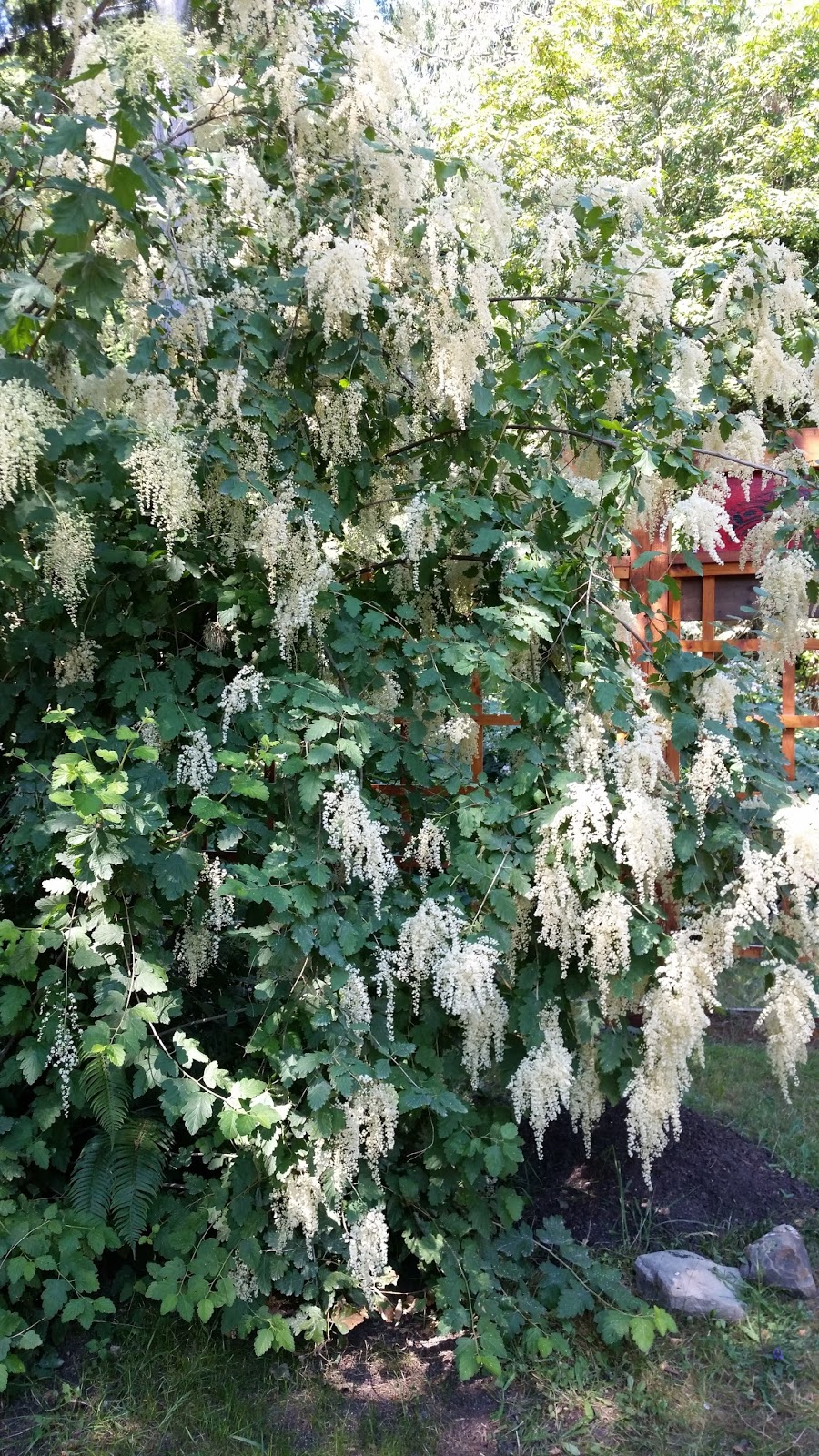
I never really noticed this Oceanspray shrub growing in our yard before this summer. It always just looked like a plain shrub, but this year it is full of beautiful clusters of wisps of cream colored blooms. Ocean Spray is a beautiful west coast native, deciduous shrub that can grow up to 20' tall. It prefers full sun and is found on dry, rocky slopes. It is remarkably tolerant of both drought and poor soil conditions. We actually have never watered this shrub.
It is beautiful this year with it's airy, lacy masses of delicate fragrant flowers, much like a bridal wedding veil. The blooms lasted from June through to August.
I am now noticing Oceanspray growing wild on the hillsides, on the rocky slopes and along the roads now. Now that they have flowered I am noticing them everywhere.
Tuesday, June 30, 2015
Yucca Plants
Yucca plants are drought resistant and can survive for many months without water. This summer I really notice the yucca plants more because a lot of the other plants are having trouble with the lack of rain.
Yuccas are members of the large agave family. Yuccas produce a flower cluster called an inforescence, made up of many individual white flowers hanging downwards in groups from a stalk or spike that can grow up to 6 ft tall. They flower once a year.
Subscribe to:
Posts (Atom)