
Thursday, September 24, 2015
Dahlias
My dahlia plants have struggled all summer. First it was slugs eating the new shoots and then the hot dry weather came. Now that it is nearing the end of September they have started to perk up with the recent rains that we have been having.


Entrance Island
It doesn't matter what time of the year it is, or the time of the day. Olebar Point is a good place to go for a walk and to take pictures of Entrance Island. There is always a beautiful view from here.


Saturday, September 19, 2015
Drought on Gabriola Island - 2015
Most of our concerns on Gabriola Island this summer have been focused on the drought and the implications from it. In most of BC, 2015 has been a summer of record-breaking temperatures, droughts, water restrictions and forest fires.
On the main island of Vancouver, there was an absence of snow pack resulting in river flows dropping dramatically between April and September. Water restrictions were put in place. Water temperatures in rivers and streams then rose putting many salmon and fish at risk.
Gabriola is dependent on rain to supply us with water. Without rain we can not fill our collection tanks or refurbish our groundwater. People that do have wells are having to be very careful not to stress them by using to much water. We have no river system on this small island.
Shifting environmental conditions have depleted our groundwater supply and water is now being hauled in by truck to fill the cisterns and rain water collection tanks. We are lucky that our property has a good well and we have always been very water conscious.
On the main island of Vancouver, there was an absence of snow pack resulting in river flows dropping dramatically between April and September. Water restrictions were put in place. Water temperatures in rivers and streams then rose putting many salmon and fish at risk.
Gabriola is dependent on rain to supply us with water. Without rain we can not fill our collection tanks or refurbish our groundwater. People that do have wells are having to be very careful not to stress them by using to much water. We have no river system on this small island.
Shifting environmental conditions have depleted our groundwater supply and water is now being hauled in by truck to fill the cisterns and rain water collection tanks. We are lucky that our property has a good well and we have always been very water conscious.

Monday, September 14, 2015
Blue Heron
We started out with 5 goldfish in our small garden pond last year and this summer we are down to 4. We were never sure what happened to one of them. Possibly didn't make it through the winter or a raccoon got it. Or that is what we thought until Geo spotted a Blue Heron sitting 60 feet up in one of our cedar trees looking down into the pond scouting out his snack.
We quickly added a layer of small screen wire to the top of the pond. The plants have also filled in this summer to give the fish protection from the sun and flying predators.

We quickly added a layer of small screen wire to the top of the pond. The plants have also filled in this summer to give the fish protection from the sun and flying predators.

Tuesday, September 1, 2015
Drought on Gabriola Island
Water, water everywhere... It is a common perception that B.C. has an abundance of water and rain.
Drought is a recurrent feature of climate involving a deficiency of percipitation over an extended period of time, resulting in a water shortage.
On the mainland drought can affect the growth of agricultural crops and limit the amount of water available for irrigation. Low stream flows and little rain impacts the groundwater level. Lower stream flows can also cause warmer river temperatures which impacts fish and marine life.
On the Gulf Islands, drought season coincides with the summer tourist season and the associated increase on the demand for water. Reduced water availability during the summer can have a significant impact on the aquifers as there may not be enough water to allow for the refilling of them.
Gabriola Island is approximately 53 square kilometres of low altitude terrain. Overall, precipitation is low because it lies in the rain shadow of Vancouver Island and it's mountain ranges. Our ecosystem is unique. The aquifer system is complex and delicate. Our groundwater is derived solely from rainwater. The ground water is stored in small aquifers in the shale or sandstone in the ground solely by rain. The only real natural water storage is underground in the cracks, fractures and open spaces in the rocks. There are no other large deposits of water-bearing sand or gravel as there are in other aquifers on this continent. Winter snow is seldom seen here. There are no rivers and there are just a few small ponds/swamps/dugouts which are filled with the excess runoff in the rainy season from October to March. The soil is rarely thick enough to retain significant amounts of groundwater.
As precipitation declines in the summer months, the water tables become lower, resulting in wells being intruded by saltwater or drying up.
Being prepared to respond to droughts when they occur will help protect our water in the future. Managing and preparing for future drought is needed as there can be a decrease in our available potable water. If our ground wells are used too much it could result in a change of water quality as salt water intrusion into the coastal aquifers is possible.
The BC government is providing incentives to be water efficient by giving grants for the purchase of tanks for rain harvesting. We will need new approaches to water management as climate changes and continues to impact our water and aquatic ecosystems.
Drought is a recurrent feature of climate involving a deficiency of percipitation over an extended period of time, resulting in a water shortage.
On the mainland drought can affect the growth of agricultural crops and limit the amount of water available for irrigation. Low stream flows and little rain impacts the groundwater level. Lower stream flows can also cause warmer river temperatures which impacts fish and marine life.
On the Gulf Islands, drought season coincides with the summer tourist season and the associated increase on the demand for water. Reduced water availability during the summer can have a significant impact on the aquifers as there may not be enough water to allow for the refilling of them.
Gabriola Island is approximately 53 square kilometres of low altitude terrain. Overall, precipitation is low because it lies in the rain shadow of Vancouver Island and it's mountain ranges. Our ecosystem is unique. The aquifer system is complex and delicate. Our groundwater is derived solely from rainwater. The ground water is stored in small aquifers in the shale or sandstone in the ground solely by rain. The only real natural water storage is underground in the cracks, fractures and open spaces in the rocks. There are no other large deposits of water-bearing sand or gravel as there are in other aquifers on this continent. Winter snow is seldom seen here. There are no rivers and there are just a few small ponds/swamps/dugouts which are filled with the excess runoff in the rainy season from October to March. The soil is rarely thick enough to retain significant amounts of groundwater.
As precipitation declines in the summer months, the water tables become lower, resulting in wells being intruded by saltwater or drying up.
Being prepared to respond to droughts when they occur will help protect our water in the future. Managing and preparing for future drought is needed as there can be a decrease in our available potable water. If our ground wells are used too much it could result in a change of water quality as salt water intrusion into the coastal aquifers is possible.
The BC government is providing incentives to be water efficient by giving grants for the purchase of tanks for rain harvesting. We will need new approaches to water management as climate changes and continues to impact our water and aquatic ecosystems.
Friday, July 31, 2015
Our Flowers on Gabriola - 2015
Considering how dry the summer has been we have had a lot of nice flowers. First the camellia bloomed early in February.
Followed by the rhodos.

Our hydrangea flowers were nice, too.

Even the clematis had a lot of blooms on it. The flower color has changed from a purple to a pink this year.

Followed by the rhodos.

Our hydrangea flowers were nice, too.

Even the clematis had a lot of blooms on it. The flower color has changed from a purple to a pink this year.

Thursday, July 2, 2015
Oceanspray

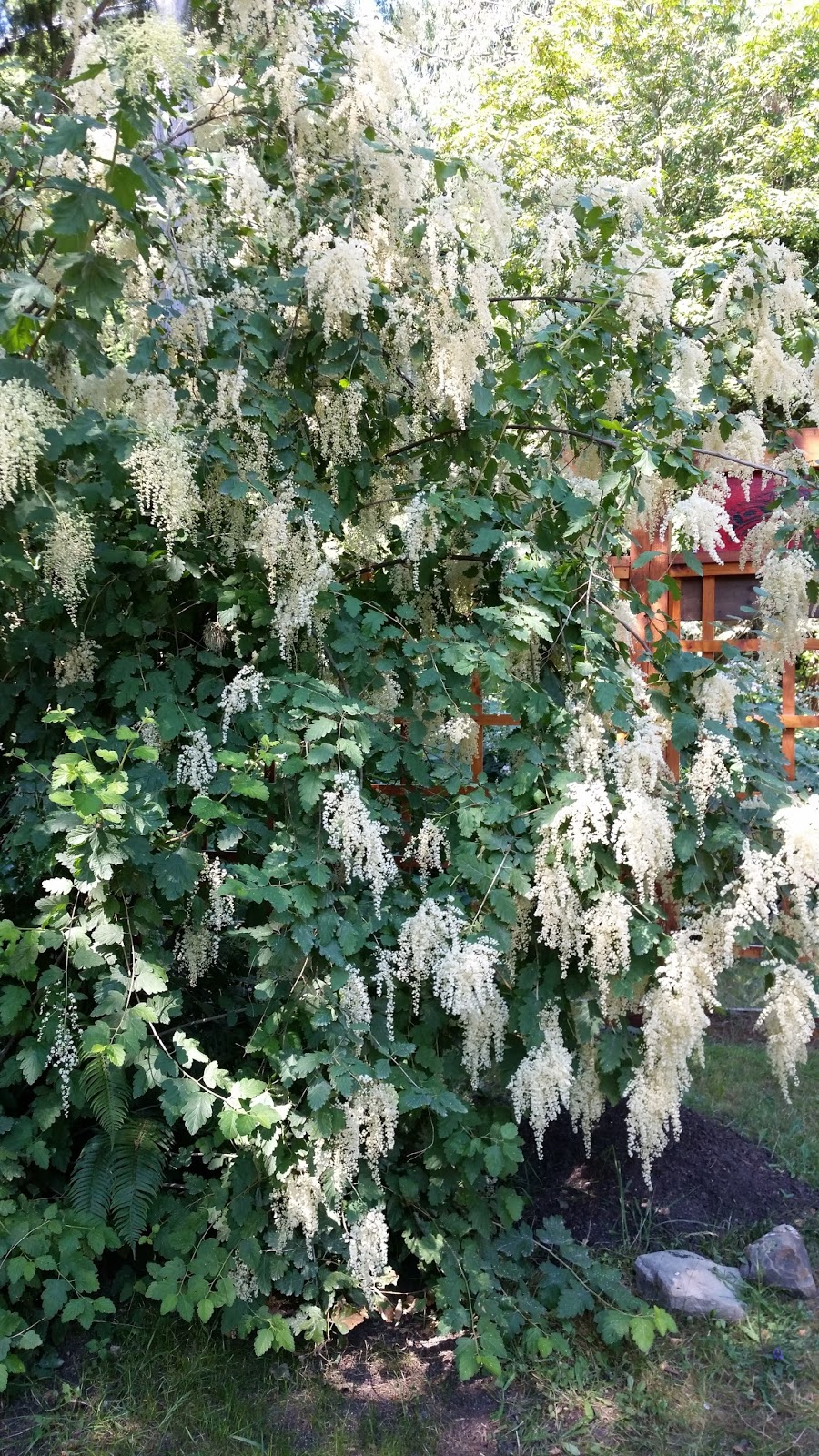
I never really noticed this Oceanspray shrub growing in our yard before this summer. It always just looked like a plain shrub, but this year it is full of beautiful clusters of wisps of cream colored blooms. Ocean Spray is a beautiful west coast native, deciduous shrub that can grow up to 20' tall. It prefers full sun and is found on dry, rocky slopes. It is remarkably tolerant of both drought and poor soil conditions. We actually have never watered this shrub.
It is beautiful this year with it's airy, lacy masses of delicate fragrant flowers, much like a bridal wedding veil. The blooms lasted from June through to August.
I am now noticing Oceanspray growing wild on the hillsides, on the rocky slopes and along the roads now. Now that they have flowered I am noticing them everywhere.
Tuesday, June 30, 2015
Yucca Plants
Yucca plants are drought resistant and can survive for many months without water. This summer I really notice the yucca plants more because a lot of the other plants are having trouble with the lack of rain.
Yuccas are members of the large agave family. Yuccas produce a flower cluster called an inforescence, made up of many individual white flowers hanging downwards in groups from a stalk or spike that can grow up to 6 ft tall. They flower once a year.

Yuccas are members of the large agave family. Yuccas produce a flower cluster called an inforescence, made up of many individual white flowers hanging downwards in groups from a stalk or spike that can grow up to 6 ft tall. They flower once a year.

Monday, February 23, 2015
Taking down trees and chopping firewood on Gabriola Island
We have just finished taking down 8 big cedar trees that were approx. 70ft tall in the back of our house to open our yard up to sunlight and so that we can build a garage when the time comes.

In the front yard we have taken down a clump maple that was 70 ft tall and consisted of 4 main trunks. Some of this maple clump had rotten and during the snowfall last Feb. the tree was bent over with the weight of the heavy snow.
After having the trees limbed and cut, we sold some of the long cedar lengths. The rest Geo and his crew are chopping and splitting for firewood. It looks like at least 10 cords of firewood for next winter.

Our wood stove will be glowing and hot next winter!

In the front yard we have taken down a clump maple that was 70 ft tall and consisted of 4 main trunks. Some of this maple clump had rotten and during the snowfall last Feb. the tree was bent over with the weight of the heavy snow.
After having the trees limbed and cut, we sold some of the long cedar lengths. The rest Geo and his crew are chopping and splitting for firewood. It looks like at least 10 cords of firewood for next winter.
Thursday, February 19, 2015


Friday, February 6, 2015
Page's Marina, Gabriola Island
It's chilly and foggy today. We are checking out our boat to make sure it is okay after bringing it up by sea from Victoria.

We have leased a stall from them to keep our boat in year round.
We have leased a stall from them to keep our boat in year round.
Thursday, February 5, 2015
Silva Bay, Gabriola Island
Geo and I have taken our boat out for a little run around near Silva Bay. It is interesting watching the float planes landing right close in the marina.

Monday, February 2, 2015
Our Boat on Gabriola Island
We've decided to get a boat as there are so many different islands around here to see and we can get some fishing and prawning in, too.


Magnolia Blossoms Inside
We moved our Magnolia shrub inside in December because of the cold nights. The leaves have come back on it and it has decided to blossom now. It smells incredible.

Subscribe to:
Posts (Atom)